The clock is ticking on 30×30, as the world looks for proof that connected conservation works at scale.
Earlier this month, delegates from nearly 200 countries met in Yerevan, Armenia, for COP17, the 17th meeting of the Conference of the Parties to the Convention on Biological Diversity, to measure how far the world has come toward the Kunming-Montreal Global Biodiversity Framework (KMGBF) and its goal of conserving 30 percent of land and waters by 2030. For more than three decades, Y2Y and our partners’ work across the Rocky Mountains, continues to offer a model that other regions can adapt.
The bottom line? The closing conference review from participating countries noted that unless action is rapidly accelerated, the goal to reverse nature loss by 2030 will not happen at this pace.
Here are the top takeaways from COP17:
- The world is currently not on track to achieve KMGBF’s 2030 targets, so a new pathway was negotiated at the conference to speed up implementation.
- Governance structure for biodiversity conservation advanced, specifically for more integration of Indigenous participation.
- Financial resources and funding to achieve biodiversity successes are still an unresolved challenge. Translating those commitments to action on the ground is the next step.
- The next four years are critical to move global framework into a measurable roadmap of implementation for meeting the 2030 biodiversity targets.
Y2Y’s vision resonates
Y2Y’s impact for large landscape connectivity works and is one of the largest conservation collaborations in history. At COP17, we brought that vision to a global audience.
Jordan Reeves, Y2Y’s director of landscape connectivity, co-chair of the IUCN Connectivity Conservation Specialist Group and co-chair of the Large-Scale Conservation Task Force, spent the week making international connections. He affirmed there is broad recognition that conservation must go far beyond just national parks and protected areas, and that connectivity is critical for long-term biodiversity protection.
“COP17 was an incredible opportunity to hear what the themes, questions, and challenges are in global conservation, and to better understand how Y2Y can contribute to inspiring solutions beyond our own landscape,” says Jordan. “Attending the conference confirmed that Y2Y’s bold vision and 30 years of impact is seen as a global model for large landscape connectivity at the scale nature needs, and an example that others aspire to replicate.”
“COP17 was an incredible opportunity to hear what the themes, questions, and challenges are in global conservation, and to better understand how Y2Y can contribute to inspiring solutions beyond our own landscape,” says Jordan Reeves, Y2Y’s director of landscape connectivity. “Attending the conference confirmed that Y2Y’s bold vision and 30 years of impact is seen as a global model for large landscape connectivity at the scale nature needs, and an example that others aspire to replicate.”
Although formal work happens at the negotiating tables between governments; the hallways, and side pavilions are where governments, international financial institutions, Indigenous and community leaders, and NGOs like Y2Y engage with each other. These moments are where knowledge is shared about what’s working and why. Patterns emerge showing where innovations, partnerships and collaborative solutions are needed. For example, Y2Y connected with conservation practitioners from South Africa and Mongolia – places with similar vast landscapes and wide roaming species.
Urgency, and the gap between 2030 goals
As 2030 quickly approaches, countries are working quickly to meet the biodiversity commitments. Governments are negotiating how to reflect connectivity and conservation beyond protected areas, such as Indigenous-protected areas, community forests and wildlife corridors. Y2Y sees wildlife crossings as one way to bridge that gap: they are tangible infrastructure with demonstrated economic returns, proven highly effective for promoting connectivity and reducing wildlife-vehicle collisions. They are also critical for ensuring that wildlife species can continue to migrate and have room to roam and reproduce as nature intends, especially as economic development and human encroachment expands.
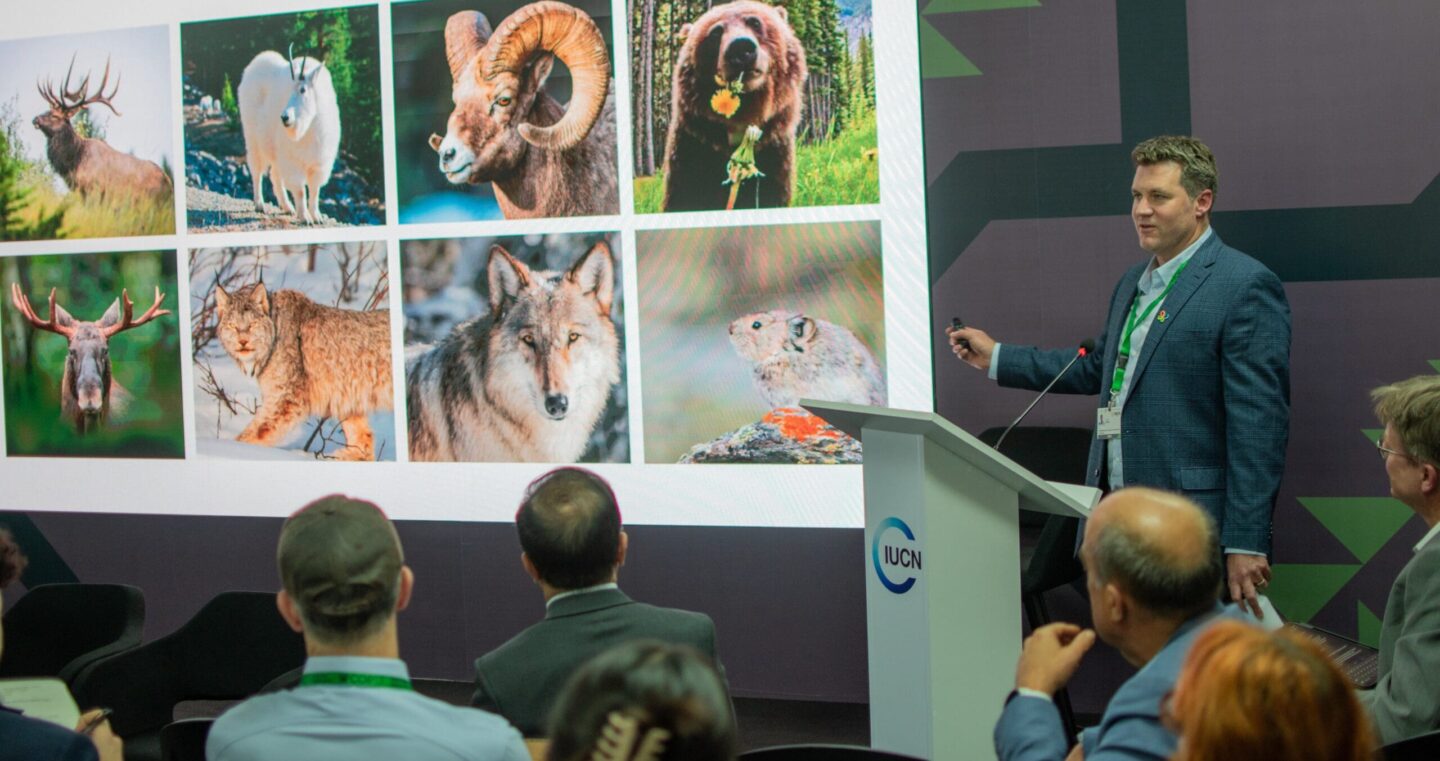
During the conference, Y2Y co-hosted a large-scale conservation task force event with the IUCN World Commission on Protected Areas, which featured Y2Y, the International Centre for Integrated Mountain Development, a transboundary Himalayan conservation initiative that includes eight countries, Altyn Dala Conservation Initiative, a fellow finalist and winner of The Earthshot Prize, and The Global Rewilding Alliance. The evening drew a diverse gathering of funders, practitioners and policymakers to explore what it takes to make protected, resilient landscapes succeed at scale.
From Armenia to the Rockies
Although the challenges differ from place to place, the global question is often the same: how do we keep nature connected as roads, development and a warming climate change habitat and the landscape?
Next year, the IUCN WCPA Protected and Conserved Areas Congress will be in Panama, a once-in-a-decade gathering, that sets conservation priorities toward 2040. Y2Y’s work on the task force, and the Connectivity Specialist Group puts Y2Y and our partners among those shaping that agenda. We’ll keep building a movement with large-scale practitioners worldwide, so that the Y2Y model can help others connect their own landscapes at the large scale that nature needs.
additional reading
30×30: Protecting 30% of Earth’s habitats by 2030
In a historic show of global unity, 196 countries have agreed to chart a path to a Nature Positive future together — committing to protect 30 percent of Earth’s lands and waters by 2030, ensuring the natural world and all the benefits it provides us with flourishes for generations to come.

Science points to Y2Y as a model
What role does science play at Yellowstone to Yukon Conservation Initiative?