Recently, the Government of Canada released A Force of Nature: Canada’s Strategy to Protect Nature — an ambitious, partnership-driven plan to protect 30 percent of lands and waters by 2030.
This is exactly the kind of bold action needed to halt and reverse biodiversity loss, and we’re thrilled to see how deeply it aligns with the work Y2Y donors and partners have supported for more than 30 years.
Habitat loss and fragmentation remain the leading causes of biodiversity loss across the Yellowstone to Yukon region and around the world. Climate change is intensifying these pressures.
Science, traditional knowledge, and decades of experience have shown us that collaborative large landscape conservation and connectivity is critical to addressing these interconnected crises. The Yellowstone to Yukon region shows that there are solutions, and they are working.
The timing is ideal. There is extraordinary alignment at this moment in time between what needs to happen and what Y2Y has been building toward since 1993.
Three pillars, one integrated approach
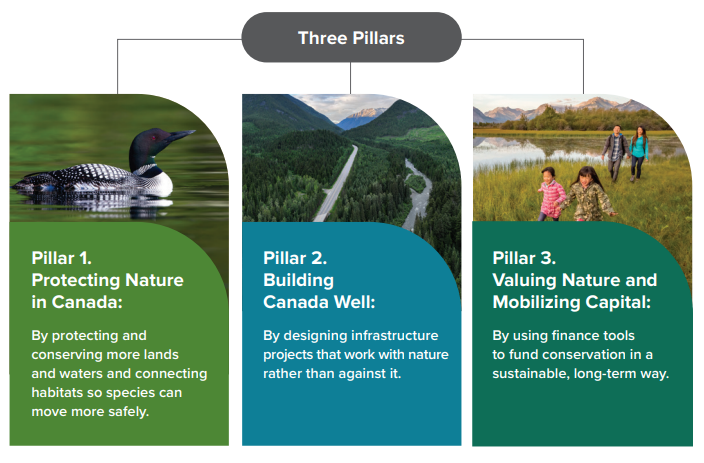
Canada’s Force of Nature plan rests on three pillars: Protecting Nature, Building Canada Well, and Valuing Nature.
If this sounds familiar, it’s because these pillars also appear in Y2Y’s integrated Nature Positive approach.
In fact, a new paper led by Y2Y co-founder Harvey Locke, published in Frontiers of Science in April 2026, provides a clear roadmap for how this integration works.
“Nature Positive: halting and reversing biodiversity loss toward restoring Earth system stability” demonstrates that saving species and fighting climate change work best when tackled together, not separately.
The research shows that healthy ecosystems: intact forests, wetlands, and oceans, are essential to keeping our planet’s climate stable because they absorb carbon, manage water cycles, and cool the climate.
What stands out
Three elements of the new strategy particularly stand out:
- Connected habitats are recognized as essential for species movement and climate adaptation — something Y2Y has championed since day one. We also partnered on the pilot for Canada’s National Program for Ecological Corridors.
- Indigenous leadership is acknowledged as foundational to conservation. Y2Y works alongside Indigenous Nations on Indigenous Protected and Conserved Areas, and this recognition reflects the collaborative approach we’ve always embraced.
- Mobilizing private capital through an Expert Taskforce on Natural Capital Accounting opens new pathways for conservation financing. Y2Y already engages with impact investors and philanthropies, and we’re ready to help unlock additional resources for on-the-ground action.
Delivering results that help nature
Recognized as a leading large landscape conservation initiative, Y2Y is uniquely positioned to play an essential role in making this strategy a reality.
As a transboundary model operating across the Rocky Mountains from Yellowstone to Yukon, we offer ready-made capacity to meet Canada’s commitments both internationally and within this nature strategy. That means:
- Shovel-ready projects in British Columbia and the Yukon can contribute 2% of Canada’s 30×30 national target, conserve intact ecosystems, support Indigenous stewardship, and directly advance new protected area goals. Our on-the-ground partnership capacity means we can help turn these proposals into completed conservation areas before the 2030 deadline.
- Cross-border collaboration is built in our foundation. Y2Y’s work is a living example of strong U.S.-Canada cooperation for nature. As Canada implements its strategy, we offer a cross-border platform to actualize continental conservation goals.
- Facilitating partnerships across jurisdictions, sectors, and constituencies is what we do. We can identify key projects, bring the right people to the table, and build the support needed for implementation.
How this scales across the Yellowstone to Yukon region
This strategy represents a watershed moment for conservation in Canada and across the region.
With your continued support, Y2Y stands ready to help deliver on its promise — protecting areas that represent 2 percent of Canada’s 30×30 target, advancing Indigenous-led conservation initiatives, and demonstrating that ambitious, connected conservation is possible when governments, non-governmental organizations, Indigenous Nations, and funders work together.
The alignment between Canada’s vision and Y2Y’s 30 years of evidence in action creates an unprecedented opportunity to accelerate outcomes for wildlife, communities, and climate.
We’re energized by what lies ahead and grateful to have you alongside us as we help turn this bold strategy into lasting conservation on the ground.
Thank you for being part of this journey.