Projects near Garrison and Superior help link ecosystems for grizzlies and other wildlife
MISSOULA, MT – Two key Western Montana habitat linkages for grizzly bears and other wide-ranging wildlife will be protected from subdivision and development after The Vital Ground Foundation and Yellowstone to Yukon Conservation Initiative (Y2Y) teamed up this month on a pair of conservation projects along Interstate 90 on either side of Missoula.
Both projects carry significance for regionwide grizzly bear connectivity, conserving low-elevation habitat at or near existing underpasses that wildlife use to cross under the interstate and connect mountain ecosystems.
Southeast of Missoula between Drummond and Garrison, the Brock Creek Project was completed with a 50-acre land purchase on the north side of I-90. Located in a linkage zone connecting the Garnet and Flint Creek mountain ranges, the site abuts an existing highway bridge span that sees regular wildlife traffic.
West of Missoula near Superior, the Nellie Creek Project protects 160 acres on the south side of the interstate via a voluntary conservation agreement with the Gould Family, whose roots on the property trace back five generations. With the Bitterroot Mountains extending to the south, an underpass near the project connects it with forestlands north of the Clark Fork River that extend into both the Northern Continental Divide and Cabinet-Yaak ecosystems.
“The Brock Creek and Nellie Creek projects are more examples of the strong partnership between landowners, Vital Ground and Y2Y,” says Eric Greenwell, Senior Connectivity Specialist at Y2Y. “As we look to the future together, we need to make smart decisions and investments to balance the shared space of wildlife corridors and roadways. These projects, near I-90, are those smart investments.”
“The Brock Creek and Nellie Creek projects are more examples of the strong partnership between landowners, Vital Ground and Y2Y,” says Eric Greenwell, Senior Connectivity Specialist at Y2Y. “As we look to the future together, we need to make smart decisions and investments to balance the shared space of wildlife corridors and roadways. These projects, near I-90, are those smart investments.”
Beyond benefits to wildlife, the projects maintain open, scenic landscapes against a backdrop of regionwide development pressures. In the case of the Nellie Creek site, a family’s long history of stewardship on the land will be honored and maintained for generations to come.
“We were interested in preserving our fifth-generation family homestead as well as open space, agricultural production, timber harvesting and wildlife habitat,” said Richard Gould, who shares ownership of the property with his brothers, Brent and Guy. “Seeing the changes happening in Western Montana, we wanted to see this place preserved. We have a lot of love for the wildlife and plants of Western Montana, and grizzly bear habitat was always in the back of my mind because they’re an umbrella species. If you can provide habitat for them, you’ve got habitat for everything else.”
Regional Connections
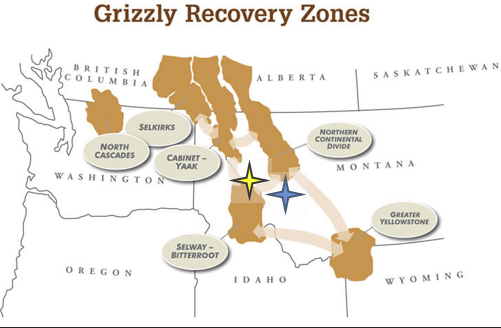
The Brock Creek site sits at the southern fringe of the Northern Continental Divide Ecosystem (NCDE)—home to Glacier National Park, the Bob Marshall Wilderness, and more than 1,000 grizzly bears—and helps wildlife move south into the High Divide area, a patchwork of wildlands that extends south toward the Greater Yellowstone Ecosystem (GYE) and represents one of the key potential pathways in regional connectivity models. One of those southbound bears was the young male dubbed Lingenpolter, a collared grizzly nicknamed by biologists who approached I-90 from the north nearly 50 times, including once at the Brock Creek site, before eventually crossing west of Drummond and moving into the Sapphire Mountains.
“We’ve had grizzly activity there off and on for the last 8-10 years,” says Jamie Jonkel, a Montana Fish, Wildlife & Parks biologist. “They’re getting into the Flint Creek and Sapphire Ranges and the John Long Mountains, bears that have crossed I-90 right through that area that this project is in. So much of it is driven by the berry load: it’s such a productive river bottom there with chokecherry and serviceberry. Many bears come down to feed on the berries, and once they’ve cleaned up the north side they start thinking, ‘How do I get to the other side?’”
The Nellie Creek Project, meanwhile, helps bears move between the Bitterroot, NCDE and Cabinet-Yaak Ecosystem. Home to a vast swath of historic grizzly habitat that no longer hosts a documented reproducing population, the Bitterroots—like the High Divide—represent a key pathway in models for north-south movement that could eventually reunite NCDE bears with their genetically-isolated counterparts in the GYE.
“Bears come through that area from the Ninemile and Flathead Reservation and down through the country south of Libby and Troy,” says Jonkel, who noted that the famed wandering grizzly nicknamed Ethyl passed through the Nellie Creek area a decade ago. “For any bears that can get across I-90 it opens up a lot of habitat to the south. There are a couple of pretty big bridge spans near there that currently allow for passage, so anything that conservation groups can do to buffer those existing underpasses and overpasses is great.”
As key habitat connections on regional and transboundary scales, both projects relied on major funding and logistical support from Y2Y while Vital Ground serves as the land trust partner. The new conservation easement on the Nellie Creek site will ensure the property is managed to maintain its high value for wildlife as well as its rural, scenic character, including three of the family’s original homestead structures that merited listing on the National Historic Registry. Vital Ground’s stewardship of the Brock Creek acreage, meanwhile, will allow for future habitat restoration projects and potential improvement of the highway underpass.
“Strategic conservation investments like Brock Creek and voluntary, private land conservation efforts by landowners like the Goulds at Nellie Creek will ensure bears and other wildlife have secure habitat as they move across the landscape, even when those movements take them near transportation corridors” said Mitch Doherty, Conservation Director for Vital Ground. “With a lot of recent momentum for wildlife accommodations on our roadways at the state and federal levels, I’m excited to see what the future holds for these conservation investments and how Vital Ground can support regional wildlife movement.”
In addition to Y2Y, the Nellie Creek Project relied on major support from the Cinnabar Foundation while the Brock Creek Project succeeded thanks to support from Atira Conservation and the Heart of the Rockies Keep It Connected Program.
Related Stories
Creating vital connections
Connected landscapes are a lifeline for ecosystems, helping animals to find food, water and mates.
Maintaining a vital link for grizzly bears and other wildlife in Montana
Collaborative conservation builds brings lasting solutions for land, wildlife and people to increase connectivity in part of the Yellowstone to Yukon region.